All You Need to Know About Floor Area Ratio (FAR)
The real estate business has numerous terminologies which are not easy to understand at the time of purchasing a new house. Floor Area Ratio (FAR) is one of the terms that is frequently used. It is a withering concept, which has a direct impact on the extent of building that can be carried out on a piece of land.
When purchasing a house, investing in land, or setting up a construction, there is a possibility that you simply need to know FAR so that you can have a clear understanding of what development the property can potentially have. It also determines building height, number of floors and density of a project.
Our article will simply define FAR and calculate it, along with its significance, and the way it influences the decision to buy a property.
What is Floor Area Ratio?
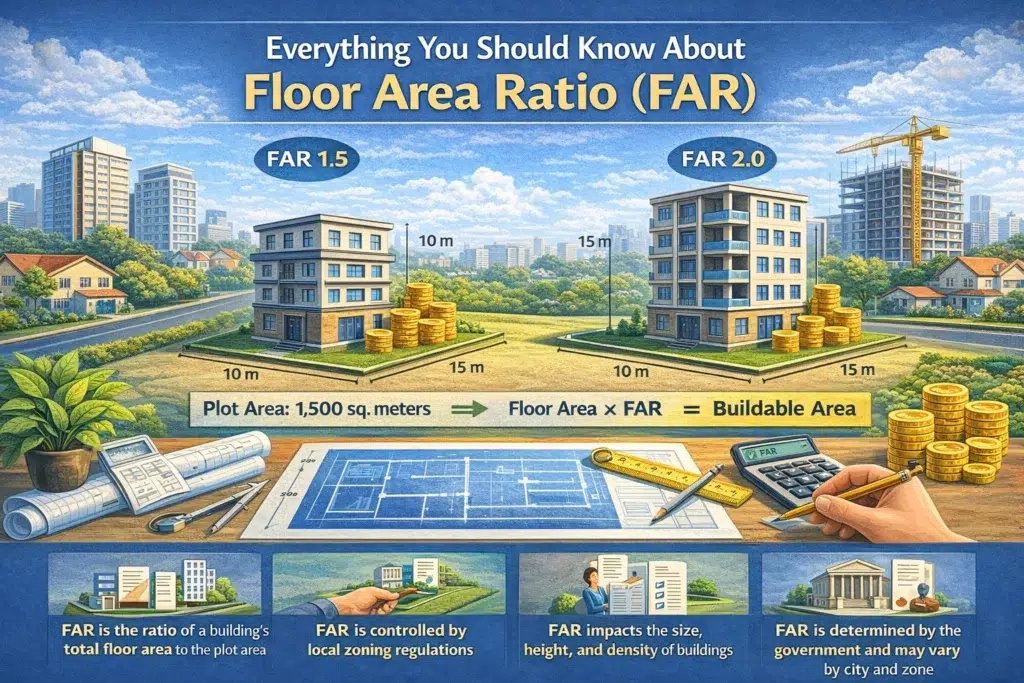
Floor Area Ratio (FAR) is the ratio between the area built-up within a building and the size of the plot in which the building has been built.
In plain English, it informs you the extent of the construction that can be done on a given piece of land.
Local authorities determine FAR in order to regulate the construction and to guarantee that infrastructure, including roads, water supply and drainage, is not overloaded. It assists in balancing the construction and the space.
In case the FAR is increased, additional construction is permitted. In case the FAR is less, the constraint of construction is minimized.
Floor Area Ratio Calculation
The equation used to compute FAR is:
FAR = Built-up Area/ Plot Area.
We will know this by an example.
Assuming that you have a plot that is 1,000 square feet with the FAR that is permitted to be 2, then there will be a total construction permitted of 2,000 square feet.
This summative space may be separated on floors. For example:
Ground floor – 1,000 sq ft
First floor – 1,000 sq ft
Total built-up area = 2,000 sq ft
This indicates that FAR restricts the overall construction area, and not the number of floors.
FAR vs FSI – Are They Different?
It is believed that FAR and FSI are not the same, however, they are identical.
The distinction lies in language only.
In India, one may refer to the FSI (Floor Space Index). FAR is more commonly used in other countries.
They are both the same calculation; the ratio of built-up area to the size of the plot.
Why Floor Area Ratio is Important
FAR is hugely involved in real estate development and planning in cities.
It assists in regulating the density of development of an area. In the absence of FAR limits, construction might have no planning and get congested.
The use of land is also efficient through FAR. In metropolitan areas where there is a scarcity of land, an increase in FAR permits increased utilization.
Infrastructure management is another key issue. FAR limitations are used to ensure that the roads, drainage systems and utilities are able to sustain the population in the area.
To developers, FAR serves as a guide in project planning such as the number of the floor or units to be constructed.
How FAR Affects Residential Projects
FAR has a direct effect on the way a residential project is planned and the experience of staying at the place.
Projects that have a lower FAR tend to have a more open space. This implies improved lighting, ventilation, and congestion.
Conversely, there are more units and buildings in projects that are of high FAR. Although this enhances the availability of housing, it may equally make the project appear more dense.
The amenities are also affected by FAR. Lower FAR projects tend to be more spacious with parks and recreational facilities whereas higher FAR projects are more concerned with the built-up area.
How FAR Impacts Property Prices
FAR does not directly determine the prices of properties, but indirectly.
In regions with a low land area, an increase in FAR enables more construction, which may raise housing supply and price.
Meanwhile, houses having a lower FAR usually have better living conditions including increased space and congestion. This may render them more attractive and even more costly.
Thus, FAR contributes to the supply and the demand, which determines the value of a property.
Why FAR Varies from Location to Location
FAR does not exist everywhere. It is different based on a number of factors.
Higher FAR is typically permitted in locations that have good infrastructure and demand like that of a city center.
Road width is also important. Tables may be increased to wider roads, thus encouraging more traffic.
Zoning laws have an impact on FAR too. The limits are found to be different in residential, commercial and mixed-use areas.
All these factors are taken into consideration by local authorities, and the determination of the FAR of the particular location is made.
Advantages of FAR Regulations
FAR rules aid in sustainability of planned and organized development.
They ensure that there is no uncontrolled building and minimise the chances of overcrowding.
There is also efficient use of land through FAR particularly in the urban areas where there is limited space.
It is also clear to the buyers and developers because they understand the extent to which they are permitted to construct them.
In general, FAR assists in ensuring a development-infrastructure balance.
Limitations of FAR
Although FAR is helpful, it has a few drawbacks.
With improper management, higher FAR can result in congestions. Excessive number of buildings within a small space may strain infrastructure.
Smaller FAR, conversely, can reduce development potential and decrease the number of housing units in the industry.
A balance between high and low FAR should therefore be followed.
How FAR Impacts Buyers
FAR will have an impact, whether you intend to construct or not, as a buyer.
It becomes the definition of the degree of a high or thick project and the free area.
It has an impact as well on future redevelopment potential. Unutilized FAR properties can have a better long term value.
The knowledge of FAR will enable you to select a property that will suit your lifestyle and investment objectives.
Conclusion
Another concept that is of significance is the Floor Area Ratio (FAR) which defines the area of construction that can be done on a given piece of land. It is important in city planning, property development and living conditions.
To buyers, investors and developers, the knowledge of FAR aids in making a good decision. It provides a clear picture of what can be made out of a piece of land and what will be expected in terms of space and density.
It is always important to research on the FAR laws in the locality before purchasing any property. This is a small step that can make you make a better and more confident decision.