Different Types of Property Deeds in India: A Complete Guide
In India, property dealings are known to be accompanied by a number of legal documents that define the rights of the transacting parties and ownership. One of these documents is the property deeds. The deed is a document that is legally binding, which proves the transfer or ownership of a property.
It is also important that property buyers, sellers, and investors understand the different kinds of deeds that are being used in India. All the deeds have a certain purpose based on the kind of transaction, be it a sale, gift, lease or transfer of property rights.
This guide describes the various types of deeds that are usually employed in India and their relevance in property dealings.
What is a Property Deed?
A property deed is a legal document that captures the transfer of ownership or rights in a property between one party and another. It holds critical details, including the specifics of the property, the entities that are involved in the transaction, and the terms upon which the transfer occurs.
A deed correctly done and registered with the authority concerned is official evidence of ownership or transfer of rights once it is duly done and registered.
Actions are necessary to make sure that the transactions on the property are transparent, legal, and documented.
Common Types of Deeds in India
Various forms of deeds apply based on the nature of the transaction of property. Some of the most prevalent deeds in the Indian real estate system are below.
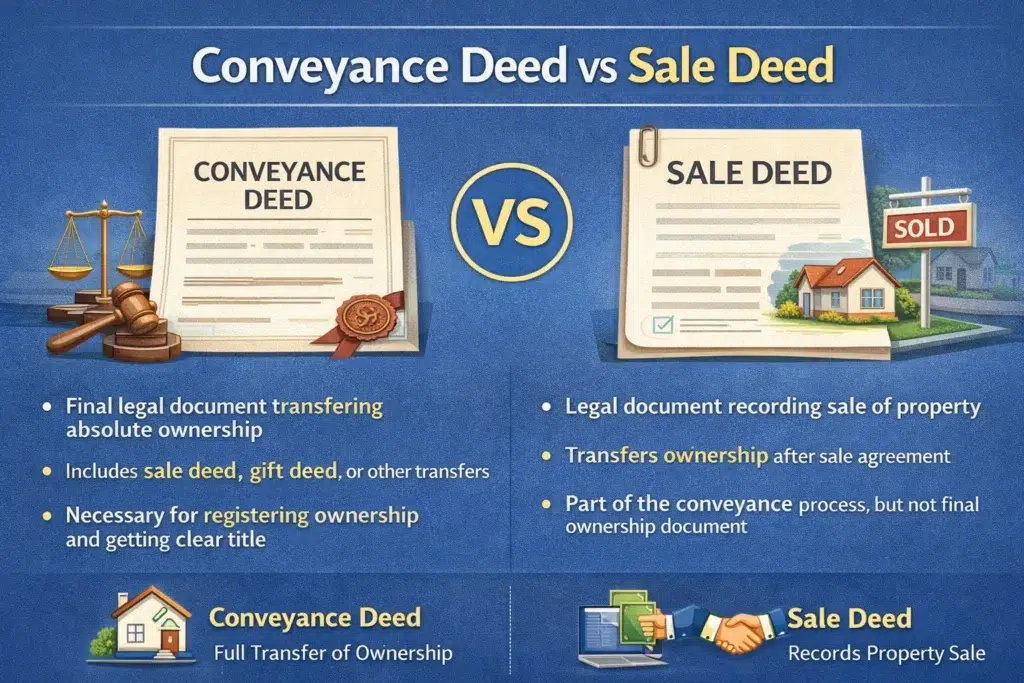
Sale Deed
A sale deed is one of the most important documents in a property deal. It establishes the transfer of property ownership between a seller and a buyer at an agreed price.
The sale deed contains the details as follows:
- Names of the buyer and seller
- Premises description.
- Agreed sale price
- Payment terms
- Date of transfer of ownership.
When the sale is registered to the office of the sub- registrar, the property becomes the legal possession of the buyer.
Gift Deed
A gift deed is applied when the owner of a piece of property voluntarily transfers ownership of the property to another individual without any form of payment.
The gift deeds are typically employed in case of property transfer between family members. This has to be clearly stated in the document that the transfer is without monetary consideration.
After registration, the holder of the gift is completely in possession of the property.
Lease Deed
A lease deed is employed whereby the owner of a property permits another individual to utilize the property over a given time as a payment of rent or a lease.
The lease deed usually carries the details like:
- Duration of the lease
- Rental amount
- Conditions of use
- Right and obligation of the two parties.
This is a form of deed that does not convey ownership but provides some interim rights to occupy or use the property.
Mortgage Deed
A mortgage deed is developed when a mortgage loan is obtained against the security of the property. The borrower remains the owner of the property, yet gives the lender some rights until he or she repays the loan.
The document outlines:
Loan amount
Interest rate
Repayment terms
The circumstances in which the lender is allowed to take possession of the property in case the loan loan is not paid.
Home loan transactions usually involve the use of mortgage deeds.
Partition Deed
A partition deed is applied when an undivided property is apportioned amongst co-owners. The division of shares in this document is clear in that each owner is given a share once the property is divided.
The partition deeds are usually applied when it comes to family-owned properties or inherited property.
After the partition deed is registered, the respective owners are awarded individual rights of ownership of their own share of the property.
Settlement Deed
Property ownership is transferred through a settlement deed among family members, which is typically done to resolve family affairs or share property.
The aim of this act is to prevent conflict in the future by specifying the ownership.
Settlement deeds are normally applied when the property owners want to share wealth among the family members during their lifetime.
Release Deed
A release deed is signed when one of the co-owners of a property transfers their rights to another co-owner.
As an illustration, when two brothers bequeath some property to each other and either chooses to sell their portion to the other, a deed of release can be signed to convey that portion of property.
Exchange Deed
An exchange deed is used when two parties mutually agree to swap properties instead of buying or selling them.
In this type of transaction, both parties transfer ownership of their respective properties to each other under agreed terms.
Importance of Property Deeds
Deeds of property are required to ensure that the property transactions are legal and well recorded.
Establishes Legal Ownership
A registered deed is an official evidence of property rights and safeguards the rights of the property owner.
Prevents Legal Disputes
Well-recorded actions foster the minimization of conflicts in ownership or property rights.
Property Transactions Requirement.
There must be deeds to sell a property, transfer ownership, loans, and inheritance.
Ensures Transparency
Deeds are used to make the transaction transparent between the parties involved by recording all terms and conditions.
Conclusion
The legal basis of real estate transactions in India is the property deeds. All forms of deeds have a particular purpose, be it selling property, giving away property to a family member, renting a property over a certain duration or splitting property among co-owners.
Knowledge of the various types of actions undertaken in India can enable property purchasers and buyers to transact real estate dealings more easily. It is always good to check the deed before signing any property document to ensure that the deed is duly registered to safeguard your legal rights.