Why Devangondi Is Whitefield’s Most Underrated Investment Pocket in 2026
Introduction
Most people who’ve lived and worked in Whitefield for a few years go through the same thought process eventually. They look at what they’re paying in rent, they look at what flats cost anywhere within 10 km of their office, and they start asking a question they didn’t think they’d be asking: is there somewhere close enough to Whitefield that’s still affordable, still liveable, and still growing?
For a long time, there wasn’t a clean answer. Sarjapur was affordable — and then it wasn’t. Budigere Cross offered options, but connectivity was patchy. Hoskote had the prices but felt too industrial and too far.
In 2026, the answer is becoming clearer. And it’s a place most people in Bangalore real estate haven’t fully factored in yet: Devangondi.
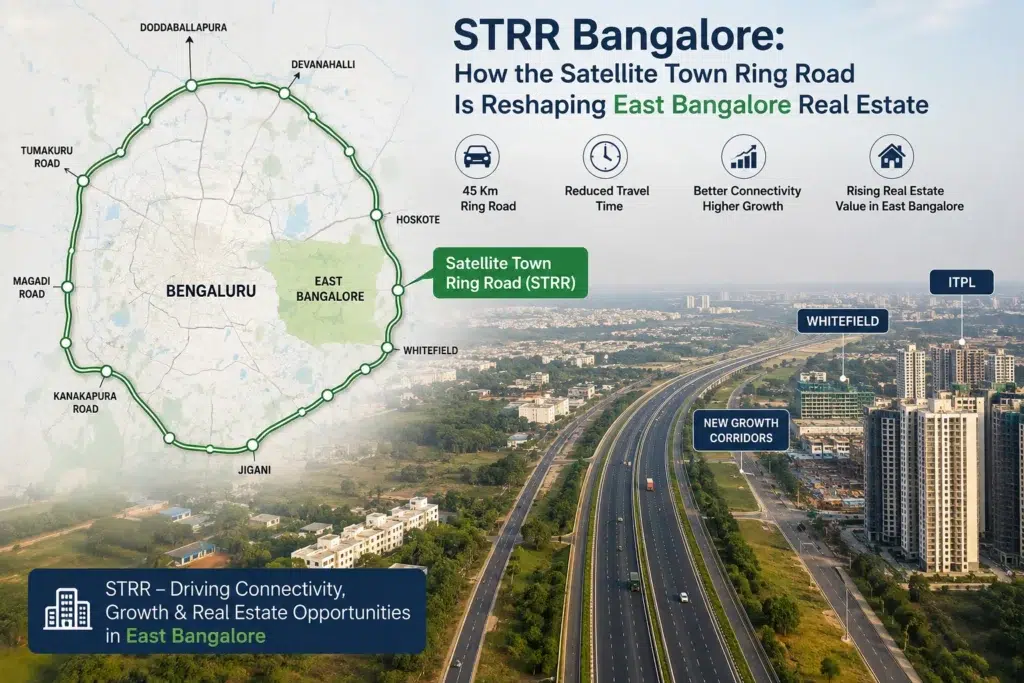
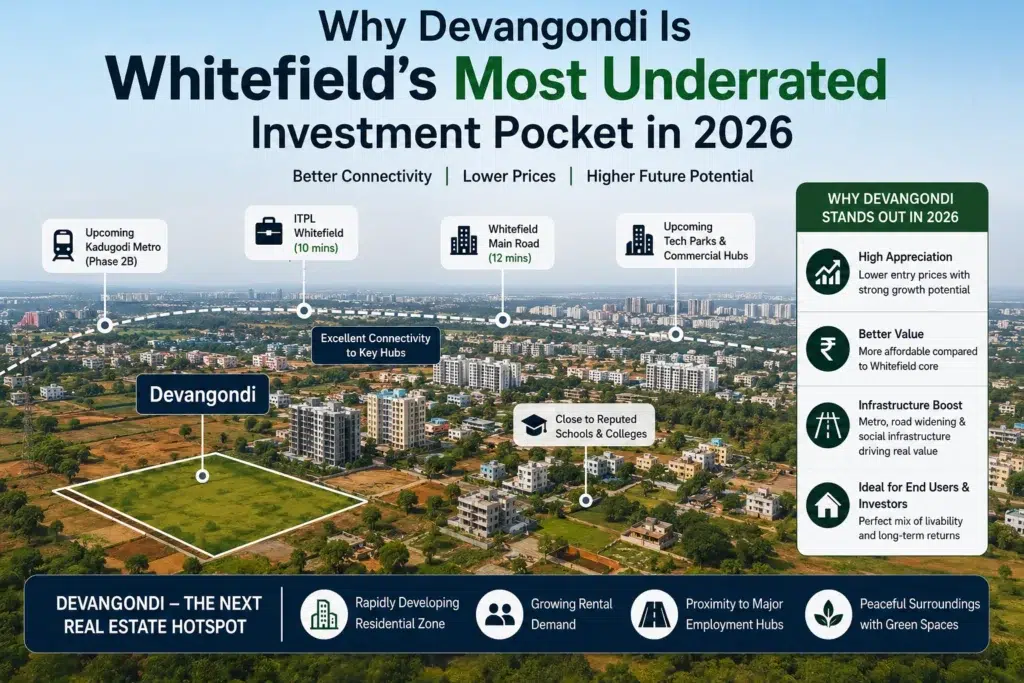
This isn’t a breathless “undiscovered gem” pitch. Devangondi isn’t a secret — it’s a Hobli within Hoskote Taluk that sits right along the STRR alignment with Whitefield roughly 15–20 kilometres to its west. What makes it worth a serious conversation right now is timing. The infrastructure pieces that typically precede a micro-market’s price surge are falling into place — STRR construction progress, metro Phase 2 planning, plotted and villa project launches from credible developers — but the prices haven’t caught up to that reality yet.
That gap won’t last forever. This article explains why.
Where Exactly Is Devangondi?
Before talking about investment potential, it helps to get the geography right, because “near Whitefield” gets used loosely in real estate marketing, and it leads to disappointment when buyers visit.
Devangondi is a village and Hobli within Hoskote Taluk, Bangalore Rural district. It sits along the NH648 (Old Madras Road) corridor, east of Whitefield. In terms of actual driving distance:
- Whitefield (ITPL gate): approximately 18–22 km, depending on the route
- KR Puram junction: approximately 25–28 km
- Hoskote town centre: approximately 8–10 km
- STRR alignment: the road runs directly through or immediately adjacent to the Devangondi area — several project sites in the zone are 200–500 metres from the STRR corridor
The surrounding character is still predominantly open — agricultural land, patches of forest reserve, water bodies, and a 700-acre forest backdrop to the north. For buyers who’ve lived in the dense apartment corridors of Whitefield or Marathahalli, this open character is genuinely striking. You don’t get that kind of breathing room anywhere within 5 km of ITPL at any price point.
The Infrastructure Case: Why 2026 Is Different
Devangondi’s case as an investment location isn’t new. People have been watching this zone for a few years. What’s different in 2026 is that the infrastructure triggers that were previously “upcoming” are now either under active construction or reaching completion.
STRR Progress — From Plan to Ground
The Satellite Town Ring Road’s eastern corridor, which passes through or immediately flanks the Devangondi-Hoskote zone, has moved from planning to visible construction. This matters because property markets respond to physical evidence of infrastructure, not just government announcements.
When commuters start seeing STRR pillars going up along the Old Madras Road-adjacent stretches, the mental model of “that area is too far” begins to break down. Devangondi’s effective distance from Whitefield’s employment centres doesn’t change in kilometres — but it changes significantly in commute time once the STRR is functional.
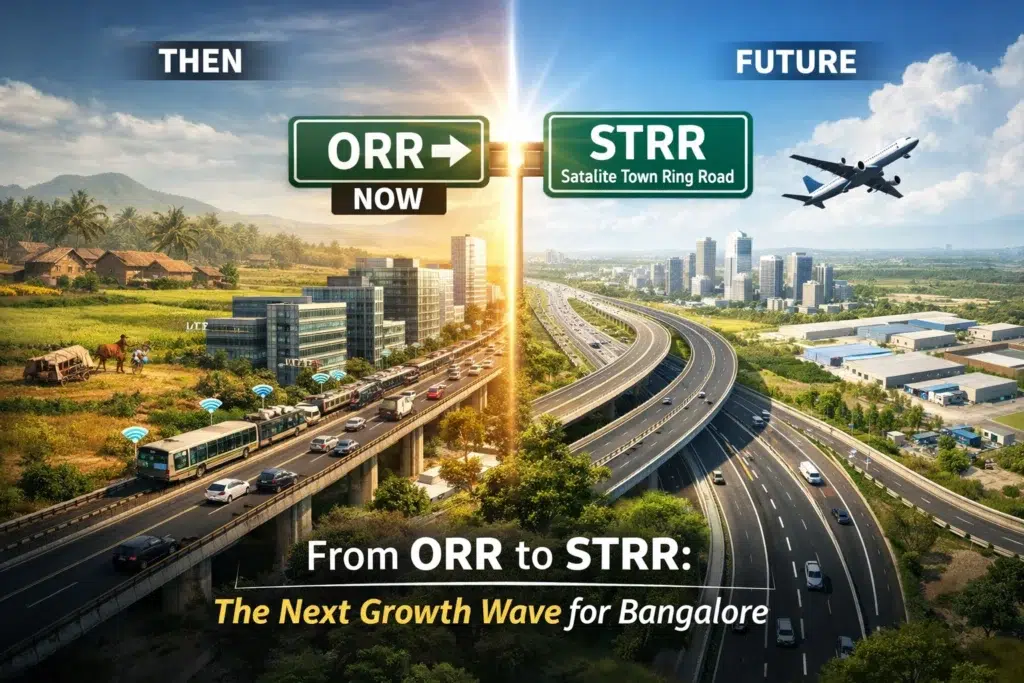
The STRR will allow residents in this corridor to access Whitefield without the bottleneck of internal Hoskote roads or the congested NH748 stretch. That’s the same dynamic that made living off the ORR viable when it opened — the ring road created a new commute corridor that didn’t exist before.
Whitefield Metro Phase 2 — The Secondary Multiplier
The Namma Metro’s Phase 2 extension toward Whitefield, once its eastern terminal catchment area is established, will create a public transit anchor for the entire east Bangalore corridor. Metro access, even indirectly via feeder routes from STRR-adjacent zones, changes the profile of an area significantly — particularly for younger professionals who don’t want to rely entirely on personal vehicles.
Devangondi is not walking distance from a metro station — and any content that claims otherwise is overselling. But with the STRR providing a fast road spine, feeder connectivity to Whitefield’s metro catchment becomes practical for daily commuters.
NH648 Widening
The NH648 (Old Madras Road) that runs through this corridor has been under widening and improvement works. As a national highway, this road sees central government-level maintenance and investment — unlike state or panchayat roads, it’s less subject to the maintenance variability that plagues many Bangalore peripheral corridors.
A widened NH648 combined with STRR access gives the Devangondi zone two road corridors to Whitefield, which significantly reduces commute risk from a single-road dependency.
Why Devangondi Specifically — Not Just “Hoskote”
When people talk about East Bangalore’s emerging real estate market, they often lump everything under “Hoskote” — the way they used to lump everything south of Koramangala under “Sarjapur.” But within the Hoskote Taluk area, there’s meaningful variation in what makes one zone more attractive than another for residential investment.
Devangondi’s specific advantages over other parts of Hoskote taluk are worth spelling out:
STRR proximity is more direct. The STRR alignment in this stretch runs closer to Devangondi than to Hoskote town itself. For buyers whose thesis is “buy near STRR before it’s complete,” this geography matters.
The land character is more residential. Hoskote town and parts of its taluk carry a heavy industrial and logistics imprint — KIADB estates, warehousing clusters, and truck movement. That character makes those areas viable for commercial investment but less attractive for families buying a home. Devangondi’s surroundings — forest backdrop, lower industrial footprint, more agricultural land — give it a more natural residential character.
Forest and water features are rare assets. The 700-acre forest reserve near projects in this zone is not replicated elsewhere in the east Bangalore corridor at this price point. Urban planners and real estate valuers know that properties adjacent to protected green buffers tend to hold value better over time because supply in that specific location is permanently constrained.
Earlier in the price cycle. Budigere Cross, which is one step further west toward Whitefield, has already seen a round of appreciation. Devangondi sits one step further east, which means it’s a round of appreciation behind, in a context where the infrastructure gap between the two zones is narrowing.
Who Is Buying in Devangondi Right Now?
Understanding who is entering a market tells you something about where it’s headed. The Devangondi buyer profile in 2026 is fairly specific:
Whitefield IT employees, 30–45 years, looking at their first owned home. This is the largest group making enquiries in the corridor. They’re typically at a life stage — young children, school decisions coming up, a second income in the household — where renting a 2-BHK in Whitefield at ₹40,000+ per month feels increasingly wasteful. A villa or spacious flat with actual outdoor space, 20 km from their office, on an EMI that’s comparable to their rent, is a genuinely compelling alternative.
For this buyer, the STRR is the key variable. Their main objection to East Bangalore locations has always been commute time. As the STRR becomes more real, that objection weakens.
NRI buyers with a Bangalore connection. People with family in Bangalore who are living in the US, UK, or the Gulf and want to buy something that will appreciate and potentially be a retirement home in 10–15 years. The East Bangalore villa corridor is attractive to this group because:
- The ticket size is still manageable in dollar terms
- A furnished villa has genuine rental yield potential from the corporate rental market
- The 10-year capital appreciation story is credible given the infrastructure trajectory
Investors on a 5–8 year horizon are buying plots or pre-launch units. A smaller but active group of pure investors — typically HNIs or established families with real estate as part of their portfolio — who are positioning in this corridor before it matures. These buyers are usually not looking at listed projects alone; some are in discussions on plot purchases directly.
What Are Prices Doing? (An Honest Look)
Devangondi is not a uniformly cheap market anymore. The early wave of appreciation that comes with infrastructure announcements has already begun. But it’s also not at Whitefield prices — not even close.
Here’s the realistic picture:
Plotted development: NA-converted residential plots in organised layouts near the STRR corridor in this zone have been transacting in a range that reflects the “post-announcement, pre-completion” phase of appreciation. Prices are up from where they were three years ago, but buyers can still enter at values that compare favourably to far more mature Bangalore micro-markets.
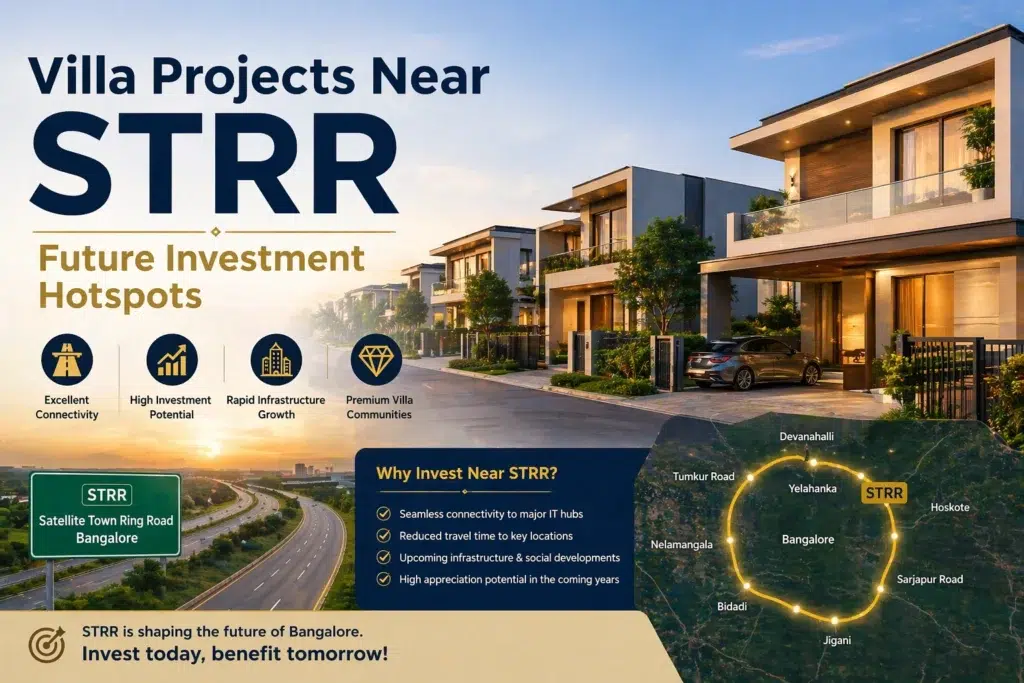
Villa projects: Launched villa projects from credible developers in this corridor are pricing their units at levels that are meaningfully below comparable villa projects in Whitefield or Sarjapur. The gap reflects the current infrastructure discount — as STRR operationalises and the corridor develops, that gap tends to close. Buyers who enter during the infrastructure discount phase have historically captured the largest appreciation.
Resale market: Thin right now — most of the buying happening in this zone is first-sale from developers, not secondary market transactions. A thin resale market means less liquidity if you need to exit quickly, which is a real risk for buyers who might need that flexibility. For buyers on a 7+ year horizon, it’s less of a concern.
The honest caveat: price appreciation in any specific micro-market depends on factors outside STRR — the quality of social infrastructure that develops around it, school quality, healthcare access, and the overall quality of the residential stock. Devangondi has good bones, but the ecosystem around it is still developing.
What Devangondi Still Needs (Be Realistic About This)
A fair article on an emerging investment location has to name what’s not there yet. Devangondi in 2026 is not a fully built-out suburb. Buyers who are expecting the full complement of Whitefield amenities at Devangondi prices are going to be disappointed.
Social infrastructure is still catching up. Good schools, hospitals, and daily retail are either in early stages or require a drive to Hoskote town or further toward Whitefield. This is the standard emerging-market situation — these facilities follow residential density, not the other way around. They will come as the population base builds, but that’s a 4–7 year process.
Access roads in parts of the zone need improvement. The STRR and NH648 are one thing; the last-mile roads connecting residential projects to these arteries are a mixed picture. Some are good. Some are under development. Buyers should physically drive the route from their prospective project to their workplace before committing — on a normal weekday, not a Sunday morning.
Monsoon flooding risk in some low-lying areas. This is true of much of Bangalore’s periphery, but east Bangalore’s flood risk is something buyers should specifically check for their plot or project location. Ask the developer for an elevation survey. Check if the project site is in a flood zone category under the revised BBMP or Hoskote panchayat maps.
These are real limitations. They’re also the reason prices haven’t already reached Whitefield levels — and for buyers who’ve done their homework on a specific well-located project, they’re risks that are manageable.
What to Look for in a Devangondi-Area Project
Given all of the above, here’s what separates a good investment from a poor one in this corridor:
RERA registration — verify it, don’t just trust the brochure. Check the project’s RERA registration number on the Karnataka RERA portal (rera.karnataka.gov.in). This gives you access to the filed documents — land title, layout plan, project timeline, and developer’s financial disclosures. No RERA number is a hard stop.
Distance from STRR as measured on survey maps, not marketing material. “STRR access” in a brochure can mean 200 metres or 5 kilometres. Ask for the survey number of the plot, look it up on Bhoomi or the NHAI project maps, and measure it yourself.
Developer’s completed project track record. Ask specifically: how many projects have they delivered? What were the original possession dates, and when did actual possession happen? Visit a completed project if possible and speak to existing residents, not just the sales team.
Natural features are a long-term value anchor. Projects adjacent to the forest reserve or existing water bodies have a supply constraint in their favour — no one can build next to a protected forest. That’s a real differentiator in long-term valuation.
Overall, township planning vs standalone plot. A well-planned gated community with internal roads, drainage, clubhouse infrastructure, and 24/7 security holds value significantly better than a standalone plot in an unorganised layout. The premium for organised township development is worth paying in an emerging market.
Frequently Asked Questions
Q. Is Devangondi a good place to invest in 2026? Devangondi offers a credible investment case in 2026 for buyers with a 5–10 year horizon. The combination of STRR proximity, natural surroundings, and still-appreciating land values makes it more attractive than more mature markets at this stage of the infrastructure cycle. As with any investment, location within Devangondi — specifically STRR proximity, RERA compliance, and developer track record — matters significantly.
Q. How far is Devangondi from Whitefield? Devangondi is approximately 18–22 km from Whitefield’s ITPL via the NH648 and connecting roads. With STRR development improving the effective commute corridor, travel times from Devangondi to Whitefield are expected to improve meaningfully.
Q. What type of properties are available in Devangondi? The dominant real estate formats in the Devangondi zone are plotted developments, villa township projects, and a growing number of apartment projects. Plotted development has historically been the first format to develop in emerging corridors, followed by villas, and then mid-rise apartments as density increases.
Q. Is Devangondi in Hoskote Taluk? Yes. Devangondi is a Hobli within Hoskote Taluk, Bangalore Rural district. This means property transactions in the area fall under Hoskote Taluk’s registration jurisdiction.
Q. What is the price of villas in Devangondi? Villa pricing in the Devangondi corridor varies by project, configuration, and developer. RERA-registered villa townships in this zone are currently priced at a meaningful discount to comparable projects in Whitefield or Sarjapur, reflecting the infrastructure discount that tends to close as road projects are completed. For current pricing on specific projects, contacting developers directly is the most reliable approach.
Q. Is land near Devangondi safe to buy? Like any peripheral Bangalore location, due diligence is critical. Verify land conversion status (agricultural to residential), RERA registration, and title through the Sub-Registrar’s office. Buying within a RERA-registered organised township significantly reduces the risk that comes with purchasing raw land.
Q. How does Devangondi compare to Budigere Cross? Budigere Cross is one step closer to Whitefield — approximately 10–12 km east of ITPL — and has been on investor radar longer. As a result, it’s already seen a round of appreciation that Devangondi is yet to fully experience. Devangondi offers more upside potential for buyers willing to accept slightly longer commute times and an earlier-stage ecosystem.
Conclusion
Devangondi is not for everyone. If you want the full social infrastructure of a mature suburb within 10 km of your office, this isn’t the right corridor yet. That will change — but it’s going to take 5–7 years to fully get there.
What Devangondi is, right now, is the rare combination that serious real estate investors look for: genuine infrastructure progress, a natural setting that can’t be replicated once urbanisation closes in, prices that still carry the infrastructure discount, and enough credible developer activity to give you confidence that the zone is genuinely developing and not just sitting on promises.
The Whitefield corridor has been doing to East Bangalore what Koramangala did to South Bangalore two decades ago — pulling the zone of desirable residential living steadily outward. Devangondi is the next natural stop on that arc.
The buyers who do well in emerging markets are usually the ones who arrive just before the narrative becomes obvious to everyone. In 2026, Devangondi is still at that point.
Written by [Author Name], Real Estate Analyst — SSP Group. Interested in villa or plot projects near Devangondi? Call +91 9019223355 or visit sspgroup.org.in