Conveyance Deed vs Sale Deed: Meaning, Differences, and Legal Importance
India has experienced a significant increase in the real estate market. The process of purchasing or selling an item of property has correspondingly become more detailed with that growth, and frankly speaking, is confounding to many. When you have ever been part of any property deal, you likely encountered words that cannot be immediately interpreted – and conveyance is one of them.
The majority of consumers are concerned with such factors as price, place, or reputation of the builder. However, the true clarity as well as the safety is in the opportunity to know the legal documents involved. The conveyance deed and the sale deed are two of the most important ones. Individuals tend to believe that they are alike, and they are not.
We can simplify it so that you can actually know what each is and why it is important.
What is a Conveyance Deed?
The conveyance deed is actually a document that authenticates that a property has been handed over by one individual to another. It demonstrates that the ownership, as well as all rights to the property, is transferred to the new owner.
Here is something most of the people do not know, a conveyance deed is not only concerned with buying and selling. It’s a broader concept. The transfer of property may be carried out in various forms such as transfer of property to a relatives, inheritance or even exchange.
In any of these, a conveyance deed is employed.
This is of great essence in the real life scenario particularly when it comes to apartment projects. Once the building is finished, the builder is expected to give the society the ownership of land and the general areas. However, in most of the cases, this action is usually postponed – and it is at this point that things may later go wrong.
Purpose of Conveyance Deed
Thing is not the conveyance deed which is a mere formality. It is in fact a major determinant in ensuring that all is clear and that it is legal.
One, it transfers routes the ownership of the seller to the buyer. Without it, though you may have paid the full sum, you are not duly established as the owner of it.
It also makes clear description of the property, such as the location, size, and boundaries. This may sound simple, but this would be highly significant in case some confusion or disagreement arises in future.
The other significant fact is that it captures the financial aspect of the transaction. It indicates the value paid and the manner in which payment was done. This maintains all open between the two parties.
And in an event of a failure in the future, say a legal problem or a claims problem, such a document serves as a good evidence in a court.
Lastly, it assists in updating government records having the property registered officially under the name of the new owner.
Documents Required for a Conveyance Deed
Trying to draft a conveyance deed, you cannot make it up just like that. You should have the right supporting documents.
But as an example, the sale agreement matters as it displays the initial terms that were agreed upon. Next are property documents or mutation records which assist in ascertaining that indeed the seller is the owner of the property.
Approved building plans and layout approvals would also be required, particularly on constructed properties. These would prove that the construction is legal.
Other certificates are also significant such as completion certificate and occupancy certificate. They indicate that the facility is completed correctly, and it is safe to utilize.
Besides that, there is a need to provide evidence of stamp duty payment and identity documentation of both the parties to make the process complete on the legal front.
Key Sections in the Conveyance Deed
Conveyance deed is not a single paragraph, but it consists of various areas that fully articulate the deal.
It begins with the information about the purchaser and the seller. Then it proceeds to the property description which contains precise measurements and boundaries.
It also includes a section that describes the sale value and the way of how the payment was carried out. This is significant in transparency.
The other important section is the legal clauses. These are the rights and obligations of the two parties.
However, the most significant part is the one that attests with the transfer of ownership. This is the essence of the whole document.
Last but not least, both parties and witnesses sign the deed and this renders it legally binding.
What is a Sale Deed?
A deed of sale is not as complex as a conveyance deed. It is applied specifically in cases where the sale of a piece of property takes place between one individual and another at a price.
All the significant information is in this document, namely, who is purchasing, selling, what is being purchased and at what price.
The ownership is transferred to the buyer once the deed of sale is signed and registered.
Practically, it is among the most significant documents that you would possess as a property owner. It serves as your primary evidence of ownership and will have to be presented each time you wish to sell the property once more, or when you wish to seek a loan.
Key Differences Between Conveyance Deed and Sale Deed
The misunderstanding of the two is very common.
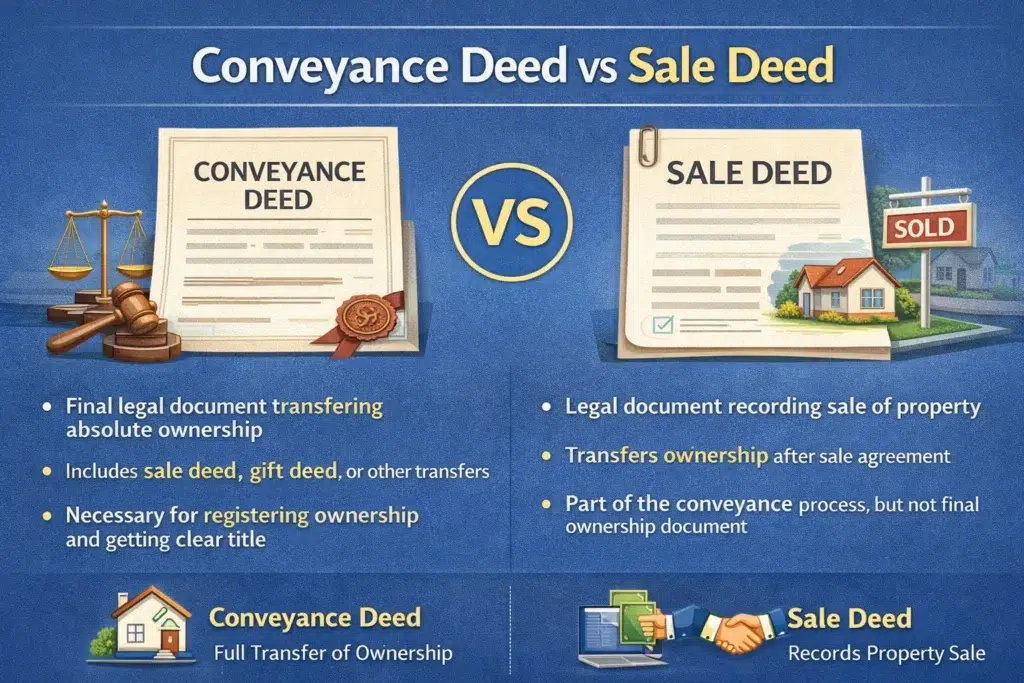
One term is conveyance deed, which is larger in term and it covers all kinds of property transfers. A sale deed in its turn is applied in case of a real sale.
Consequently, all sales actions are conveyance actions. A conveyance deed is not necessarily sale deed.
It is the easiest thing to think of.
Types of Conveyance Deeds
Different deeds of conveyance exist as the property is being transferred.
In other situations, the transfer can be voluntary as when one sells or transfers a property. In other instances, it may also be involuntary as in the case where a bank forecloses a property because of default of loans or when a court orders the foreclosure.
There are also certain forms such as gift deeds, exchange deeds, lease deeds and settlement deeds. They have different situations where they are applied, however, the underlying concept is the same – ownership transfer.
Legal Requirements You Should Know
Indian property deals are not just bilateral deals between two individuals, they are regulated by the law.
Transfer of Property Act, 1882 describes the process of the legal transfer of property. Registering these documents is mandatory as it is provided by the Registration Act, 1908.
You might not have the transaction legally recognized in case you do not register. That can cause great difficulties in the future particularly when there is a conflict.
Common Mistakes Buyers Make
Apparently, there are several mistakes that buyers commonly commit in real scenarios as witnessed.
Others do not check the papers appropriately and pay excessive attention to the words of the seller. Others believe that the moment payment has been made, it is all over.
The other error is neglecting registration or postponing registration.
These can only appear as minor things at the moment, yet they will bring significant problems in the future – particularly during reselling or lawful inspections.
Final Thoughts
By the end of the day, it not only takes legal knowledge to know the difference between a conveyance deed and a sale deed, but it is also about safeguarding your investment.
A conveyance deed encompasses the general transfer of ownership, whereas a sale deed ascertains a property sale.
When you are planning to purchase property, spend a few minutes reading these documents. It is going to save you much trouble in the future.