Everything You Should Know About Floor Area Ratio (FAR)
There are various technical terms that are applied in the regulation of land development in the real estate and urban planning. Floor Area Ratio (FAR) is one of the most crucial of them. This idea is significant in dictating the extent to which a piece of land can be used.
To developers, property buyers, and investors, knowledge of Floor Area Ratio is used in the assessment of development potential of a property. It also affects the building height, the number of the floors, and the general density of a certain space. This guide will outline the meaning of FAR, calculation methods and the importance of FAR in the development of property.
What is Floor Area Ratio?
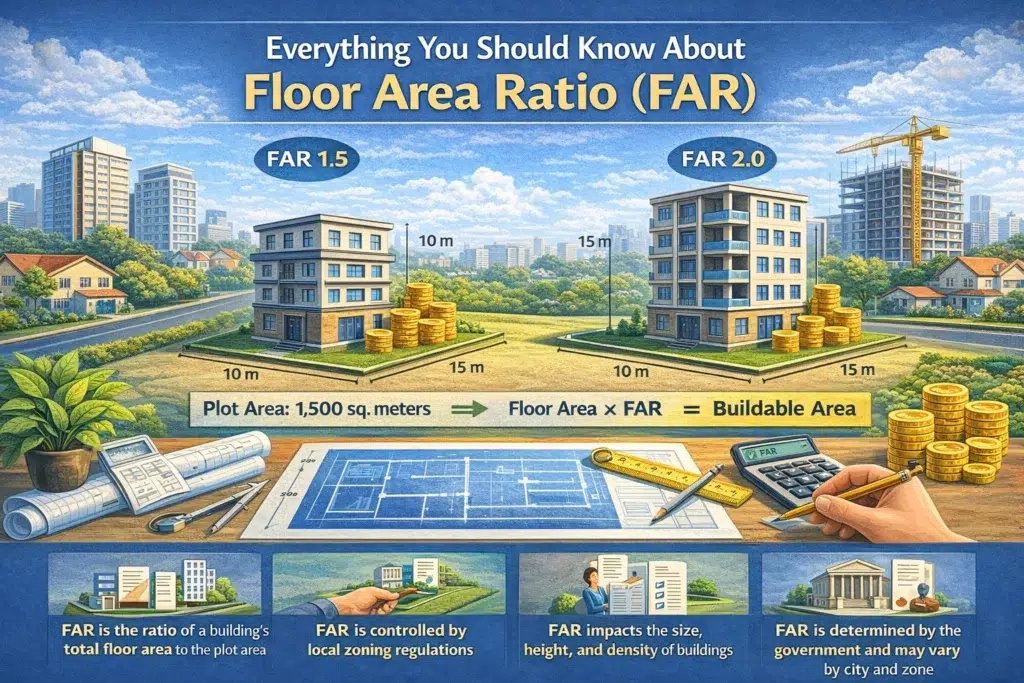
Floor Area Ratio (FAR) is the ratio of the total area of a building that has been constructed to the area of land, which is used to construct the building.
FAR is a regulation tool utilized by the urban planning authorities to control the amount of construction that can be done in a specific area. The introduction of constraints on FAR by city planners makes sure that buildings do not surpass the capacity of the local infrastructure i.e. roads, water supply, drainages etc.
FAR, in simple terms, defines the maximum area of floor space that can be made in a piece of land.
How Floor Area Ratio is Calculated
The formula of FAR is as follows:
FAR = Built-up Area/ Plot Area.
As an example, one can take a plot with the 1,500 square feet area and the permitted FAR of 2, then the total area of permitted construction would be 3,000 square feet.
It is possible to divide this total constructible area into many floors based on the building requirements in the area.
For instance:
- Ground floor – 1,000 sq ft
- First floor – 1,000 sq ft
- Second floor – 1,000 sq ft
Total construction area = 3,000 sq ft
This example shows how FAR controls the scale of development on a specific plot.
Why Floor Area Ratio is Important
Floor Area Ratio is also essential in making the urban development balanced and sustainable.
Managing Urban Density
FAR assists in controlling the level of density of an area to be constructed. Higher FAR gives taller structures and more construction space whereas lower FAR limits the size of the entire architecture.
Efficient Use of Land
FAR is also useful in cities where the land is scarce so that the land is put to good use without overcrowding.
Protecting Infrastructure
The FAR is able to limit the density of construction in order to make sure that any public infrastructure like roads, transportation systems, and utilities would be able to sustain the population within that locality.
Property Development direction.
The developers apply FAR in finding the number of floors or units that can be constructed on a piece of land. This has a direct impact on how residential or commercial projects will be designed and planned.
FAR and FSI: Are They Different?
Most people have presumed that Floor Area Ratio (FAR) and Floor Space Index (FSI) are different variables. The two terms, however, are used to mean the same calculation.
The terminology is the only difference.
FAR is normally referred to in real estate terminology of an international setting.
In India, the word more commonly employed is FSI.
They both indicate the ratio of the total floor area of a building and the plot size.
Typical FAR Limits in Urban Areas
The local urban planning authority determines the permitted FAR in a specific place. These limits can be different based on a number of factors.
Location of the Property
Real estate properties with high FAR allowances include those with high demand and good infrastructure, especially those in the central city, because it is more desired.
Road Width
Plots on broader roads can be granted higher FAR approval since they are able to accommodate more traffic and development.
Zoning Regulations
The FAR limits in various zones might vary including residential, commercial, or mixed-use areas.
Infrastructure Availability
There is also the consideration of the capacity of the local infrastructure by the authorities when deciding on the FAR limits.
Advantages of FAR Regulations
FAR regulations have a number of advantages for city planning and real estate development.
Planned City Growth
FAR assists in the avoidance of uncontrolled construction and aids in the organization of urban development.
Equal Distribution of Population.
FAR helps cities to remain small to avoid overcrowding them.
Buyers and Developers’ transparency.
Clear FAR guidelines enable property buyers and developers to know the possible extent of construction to be put on a plot.
Sustainable Urban Planning
Correct FAR regulations contribute to the achievement of a development and infrastructure capacity balance.
How FAR Impacts Property Buyers
FAR may also affect your choice of property purchase, even though you may not be a construction participant.
Determines Project Size
The increased FAR enables the developers to construct more floors or extra-large units in a construction.
Affects Property Value
Growth potential of plots with a higher FAR is probably higher, and therefore their price in the market can be higher.
Affects Future Redevelopment.
Unutilized FAR in properties can be reused in the future.
Conclusion
A major concept that dictates the extent of construction that can be done on a given piece of land is the Floor Area Ratio (FAR). It is significant in regulating the concentration of buildings, regulating infrastructures, and leading real estates.
In the case of property buyers, investors, and developers, the knowledge of FAR can assist in determining the actual development of the land and residential projects. When buying or building property, it is always a good idea to check the local regulations of FAR and building guidelines to verify that the rules of planning are adhered to.
A clear knowledge of FAR can not only assist in making informed decisions regarding real estate but it also leads to sustainable and planned urban development.