STRR Bangalore: How the Satellite Town Ring Road Is Reshaping East Bangalore Real Estate
Introduction
In Bangalore’s real estate market, infrastructure announcements move prices before a single brick is laid. We’ve seen it with the Namma Metro. We saw it with the Peripheral Ring Road corridor. And right now, the same story is quietly playing out along the Satellite Town Ring Road (STRR) — particularly in East Bangalore.
If you’ve been tracking property prices in areas like Hoskote, Devangondi, Whitefield’s eastern fringes, or Anekal, you may have already noticed the shift. Plots that were sitting unsold two years ago now have waiting lists. Villa projects that launched at modest prices have revised their rates upward.
This isn’t speculation. The STRR is under active development, and the areas it passes through are already seeing enquiries and transactions that the Outer Ring Road (ORR) saw a decade ago — before it became Bangalore’s IT backbone.
This article breaks down what the STRR actually is, which parts of East Bangalore it covers, and what it means for someone buying land, a villa, or an apartment in this corridor today.
What Is the STRR? (The Basics)
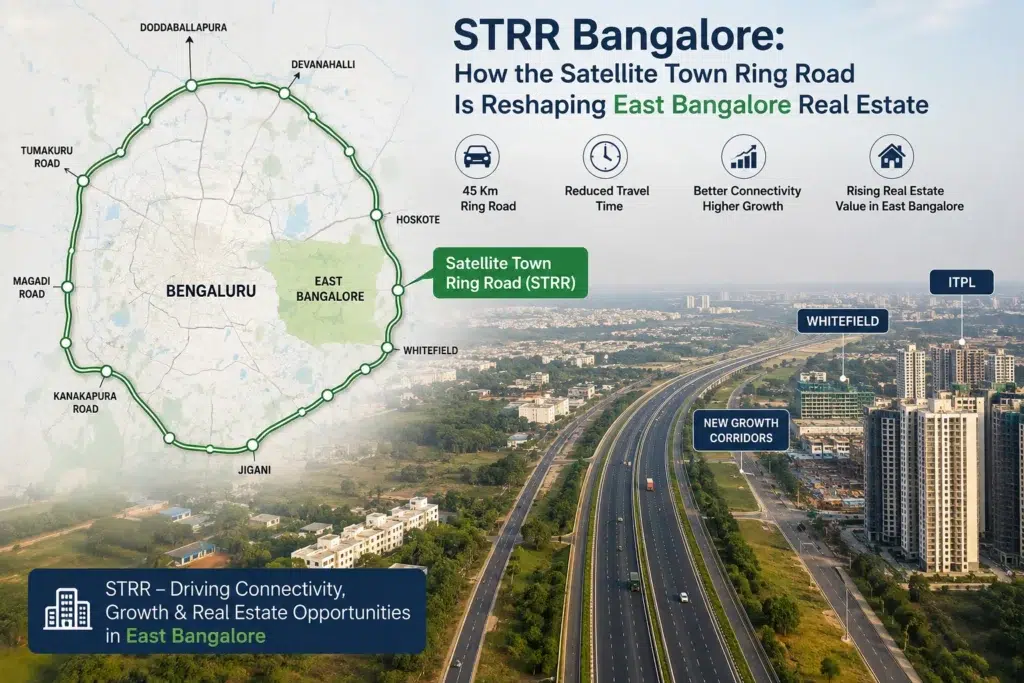
The Satellite Town Ring Road is a 281-kilometre elevated and grade-separated highway being developed around Bangalore’s outer periphery. The project is funded by the National Highways Authority of India (NHAI) and is being executed in phases.
The STRR is designed to do two things:
- Connect Bangalore’s satellite towns — Hoskote, Anekal, Kanakapura, Magadi, Nelamangala, Doddaballapur, Devanahalli — without routing traffic through the already-congested city core.
- Create a high-speed bypass for freight and interstate vehicles that currently choke NICE Road, Tumkur Road, and Old Madras Road.
The key difference between the STRR and the existing Outer Ring Road (ORR) is scale and purpose. The ORR runs through already-urbanised areas at 62 km. The STRR, at 281 km, runs through land that is currently semi-rural, agricultural, or just beginning to develop, which is exactly why it’s attracting real estate attention.
STRR Route: What It Covers in East Bangalore
The STRR passes through four broad zones of Bangalore — North, South, East, and West. For real estate purposes, the East Bangalore section is drawing the most investor interest right now, for reasons we’ll get to.
The eastern corridor of the STRR broadly runs through:
- Hoskote (Hoskote Taluk, Bangalore Rural)
- Devangondi and the surrounding Hobli areas
- Budigere Cross and Seegehalli
- KR Puram periphery and Old Madras Road intersections
- Sarjapur Road, eastern end
- Anekal and Attibele in the south-east
This stretch is significant because it runs parallel to — and in many places intersects with — the Whitefield IT corridor. Anyone who’s worked in Whitefield’s tech parks knows that the internal roads and the ORR around it are genuinely difficult to commute on. The STRR offers a way in and out of this zone that doesn’t rely on those bottlenecks.
Why East Bangalore? The Infrastructure Story Behind the Land Rush
East Bangalore was always the city’s IT spine. ITPL, Whitefield, Marathahalli, and Sarjapur Road grew organically around the tech parks that were set up there from the late 1990s. But that growth was so fast and so dense that the infrastructure never caught up cleanly.
The result: high rents, high property prices, terrible traffic, and a very real quality-of-life problem for people who live and work in that corridor.
The STRR changes the equation by opening up land roughly 15–30 km east of Whitefield — land that was previously too far from employment centres to justify a daily commute — into a genuinely viable residential zone.
Here’s what that picture looks like when you layer in the other infrastructure pieces:
Hoskote: From Industrial Town to Residential Contender
Hoskote has historically been seen as industrial land — KIADB industrial estates, warehousing, logistics. That reputation is accurate for certain pockets. But the residential land around Hoskote, particularly along the STRR alignment and NH648, is a different story.
With the STRR reducing effective commute time to Whitefield significantly, Hoskote is beginning to attract the same buyer profile that Sarjapur attracted in 2012 — people priced out of Whitefield who are willing to live 20–25 km away if the road infrastructure is reliable.
Land prices in Hoskote taluk’s outer areas are still at levels where first-time buyers can enter without taking on extreme loan burdens. That window tends to be short once a road project nears completion.
Devangondi: The Quiet Micro-Market Closest to STRR
Devangondi is not a name that appears in most Bangalore real estate roundups. That is starting to change.
Located within Hoskote Taluk and sitting very close to the STRR alignment, Devangondi has the combination that typically precedes a micro-market getting discovered: cheap land, improving road access, and proximity to a much larger urban magnet (Whitefield).
The area still retains open land — forests, water bodies, farms — which makes it attractive not just from a price standpoint but from a livability one. Buyers who are looking at villa projects specifically value that open character. Once a micro-market fully urbanises, that character is gone permanently.
Budigere Cross and Seegehalli: The Mid-Market Entry Point
If Devangondi is still early-stage, Budigere Cross sits a step further into the development cycle. It has more organised residential layouts, better access roads, and has been on the investor radar for a few years.
The STRR’s presence is consolidating Budigere Cross’s position as a mid-market residential destination. Apartment projects here have been absorbing demand from buyers who want East Bangalore connectivity without Whitefield prices.
What Has STRR Done to Property Prices? (A Realistic Look)
Infrastructure projects don’t cause overnight price jumps — that’s a myth that leads to bad investment decisions. What they do is change the long-term trajectory of demand, which gradually pulls prices upward over 5–10 years.
That said, the announcement and visible construction progress of the STRR have already moved certain metrics in the eastern corridor:
Land prices in Hoskote taluk periphery have seen meaningful appreciation over the past 3 years, with agricultural land near the STRR alignment seeing especially strong interest from investors converting to residential use.
Plotted development projects along the STRR corridor have seen faster absorption compared to similar projects in non-STRR-adjacent areas in the same price band.
Villa project enquiries in the 300–500m radius of the STRR corridor have grown — buyers who are specifically citing STRR connectivity as a reason for their location preference.
What’s driving this is not just the road itself. It’s the expectation that the STRR will follow the pattern of every other major Bangalore bypass — commercial activity clusters around interchanges, which brings retail, hospitality, schools, and healthcare, which makes the area self-sufficient, which removes the barrier of “it’s too far from everything.”
The important caveat: not all land near the STRR will appreciate equally. Micro-location within the corridor — distance from the actual alignment, access to service roads, water table, RERA compliance — matters significantly. Buyers have to do proper due diligence, not just buy anything labelled “near STRR.”
What Type of Buyer Is This Corridor Attracting?
Based on the enquiry patterns in East Bangalore’s STRR corridor, three distinct buyer profiles are emerging:
The IT Professional Moving Out of Whitefield
This is the largest group. Typically a 30–42 year old with a stable dual-income household, currently renting in Whitefield or Marathahalli at ₹35,000–60,000 per month. They’ve done the math — EMI on a villa 20 km east of their office is often lower than their current rent, and the STRR cuts what used to be a 45-minute commute to a more manageable drive.
For this buyer, the quality of the gated community, the amenities, and the developer’s track record matter more than the specific address. They’re not buying a postcode — they’re buying a lifestyle.
The NRI Investor with a Bangalore Connection
NRI buyers from the US, UK, and UAE have long favoured Bangalore real estate for its IT-sector stability. Many of them are originally from Karnataka or have family in the city.
The STRR corridor’s villa and plotted projects are attracting NRI attention specifically because the price points are still reasonable by global standards, the rental yield potential on furnished villas is improving, and the 10-year appreciation story is compelling when compared to saturated markets like Koramangala or Indiranagar.
The Long-Term Land Investor
A third group — typically HNIs or family investors — is buying farmland or NA-converted plots near the STRR alignment with a 7–10 year horizon. They’re not looking to build immediately. They’re positioning before the corridor matures.
This is higher-risk, higher-reward territory. The gains when these areas develop can be substantial, but the liquidity risk of undeveloped land is real.
Key Things to Verify Before Buying Near STRR
There’s always a gap between a project’s marketing and the on-ground reality. With STRR-adjacent projects specifically, here are the checks that matter:
RERA registration is non-negotiable. Karnataka RERA requires registration for any project above 500 sq. m. or 8 units. Check the RERA number on the Karnataka RERA portal before signing anything. Projects without RERA registration have no legal recourse for buyers if possession is delayed.
Confirm the actual distance from the STRR alignment. “Near STRR” in a sales brochure can mean anything from 200 metres to 5 kilometres. Ask for the survey number, verify it on the RERA-filed documents, and check it against the NHAI project maps published on their official site.
Check the land title and conversion status. Agricultural land in Karnataka must be legally converted to residential use (A-Khata/B-Khata situation in BBMP limits, DC conversion in panchayat limits) before a residential project can be built on it. Title encumbrances on land near highway corridors are surprisingly common.
Ask about the completion of service roads. The STRR main alignment being built does not mean the service roads connecting residential areas to it are in place. Access roads to many STRR-adjacent projects are still kacha or under development.
Evaluate the developer’s delivery history. Look at their past projects — did they deliver on time? Is there customer feedback available? A developer with 10+ completed projects and visible happy homeowner testimonials is meaningfully lower-risk than a new entrant launching their first STRR-corridor project.
The Long View: What East Bangalore’s STRR Corridor Could Look Like in 10 Years
Infrastructure changes city geography slowly, then all at once. Sarjapur Road’s transformation between 2008 and 2018 is the most relevant recent example for Bangalore. In 2008, Sarjapur Road beyond Wipro was open land and quarries. By 2018, it was one of the most sought-after residential corridors in South India.
The STRR’s eastern corridor is at a comparable point. The land use change is happening. The residential projects are coming in. The commercial activity hasn’t fully caught up yet, which is actually where the opportunity sits for buyers who can tolerate a 5–7 year development window.
By 2030, with the STRR operational and the Whitefield Metro Phase 2 integrated into the transit network, the Devangondi-Hoskote-Budigere belt has genuine potential to become the kind of address that Whitefield itself once was — aspirational but accessible.
The areas closest to STRR interchanges and with good developer-grade infrastructure will lead that transition. The ones without clear access or with title issues will lag.
Frequently Asked Questions
Q. What is the STRR in Bangalore? The Satellite Town Ring Road (STRR) is a 281-km ring road being developed around Bangalore’s outer periphery by NHAI. It connects satellite towns including Hoskote, Devanahalli, Doddaballapur, Nelamangala, Magadi, Kanakapura, and Anekal without routing traffic through the city centre.
Q. How does STRR affect property prices in East Bangalore? The STRR improves connectivity to areas 15–30 km from Whitefield and other IT hubs, making previously far-off locations viable for residential living. This increases demand for plotted developments, villa projects, and residential layouts in the Hoskote, Devangondi, and Budigere cross belt, which gradually drives price appreciation in well-located projects.
Q. Which areas in East Bangalore are closest to the STRR? The eastern STRR corridor runs closest to Hoskote, Devangondi, Budigere Cross, Seegehalli, and parts of KR Puram’s outer limit. Of these, Devangondi and Hoskote taluk areas are seeing the most active residential development directly adjacent to the alignment.
Q. Is buying property near STRR a good investment in 2024–25? It depends on the micro-location, developer credibility, and your investment horizon. STRR-adjacent projects in areas with clear land titles, RERA registration, and access roads in place offer a reasonable long-term appreciation case. Buyers with a 5–10 year horizon are better positioned than those looking for short-term flipping gains, as infrastructure-driven appreciation plays out over time.
Q. How far is Devangondi from Whitefield? Devangondi is approximately 20–25 km from Whitefield via the Old Madras Road and Hoskote link roads. With STRR connectivity improving the route, actual commute times are expected to reduce meaningfully compared to the current situation.
Q. What should I check before buying a villa or plot near STRR? Verify RERA registration on the Karnataka RERA portal, confirm the actual distance from the STRR alignment using survey numbers, check land conversion status (agricultural to residential), review the developer’s track record on past projects, and confirm access road conditions before committing.
Q. Which STRR corridor is better — East or North Bangalore? Both have strong cases. North Bangalore (near Devanahalli) benefits from Kempegowda International Airport proximity, the Aerospace SEZ, and IT park development. East Bangalore benefits from proximity to the existing Whitefield IT corridor and a larger established buyer base. The “better” corridor depends on your budget, risk appetite, and investment horizon.
Conclusion
The STRR is one of the most significant pieces of infrastructure Bangalore has seen in the last decade. It will not change East Bangalore overnight — but it is changing it, steadily, and the areas closest to its alignment are already showing it in price trends and project activity.
For buyers looking at a 5–10 year view, the window to enter at pre-development prices is narrowing. The Devangondi-Hoskote corridor, in particular, has the combination of STRR proximity, natural surroundings, and still-affordable land that tends to precede a major shift in a micro-market’s profile.
The risk, as always, is picking the wrong project — one without clear titles, without RERA, or from a developer who can’t show a completion track record. Infrastructure can lift an area, but it can’t rescue a bad land deal.
Do your due diligence on the project, not just the location.
Written by SSP Group, Real Estate Analyst — SSP Group. For site visits, RERA details, or investment queries: call +91 9019223355 or visit sspgroup.org.in