
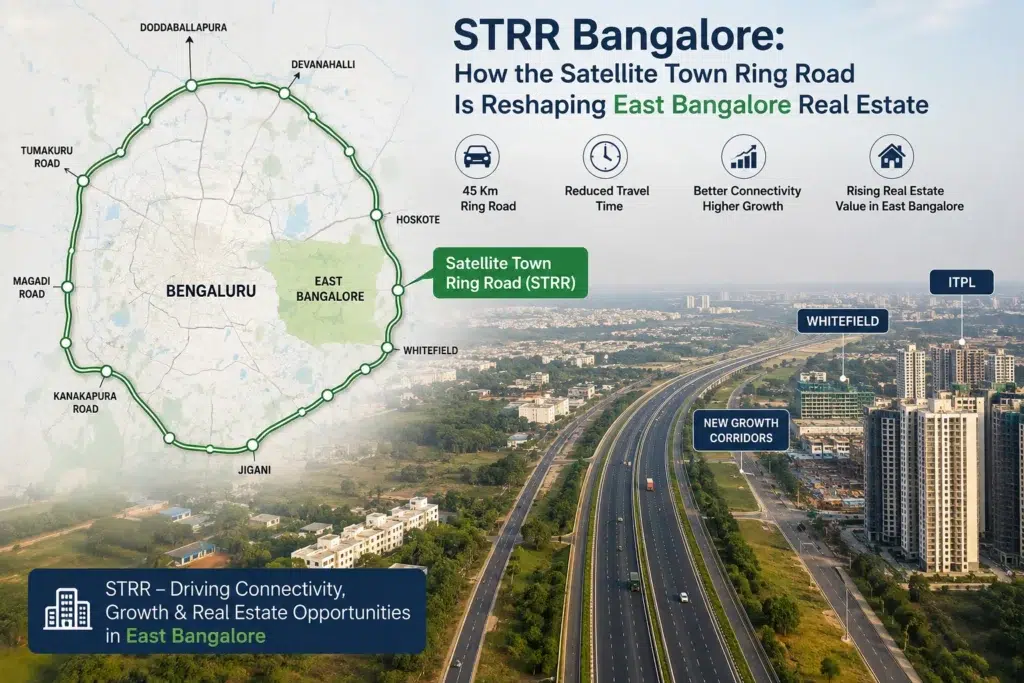
STRR Bangalore: How the Satellite Town Ring Road Is Reshaping East Bangalore Real Estate
Introduction
It’s a pattern that’s played out in the Bangalore real estate scene for years. Price movements tend to occur even before the first brick is laid. We saw it happen with the Namma Metro. We saw it happen with the Peripheral Ring Road corridor. We are witnessing it happen, albeit in quieter whispers right now, along the Satellite Town Ring Road (STRR) – and we’re especially seeing it along the East Bangalore stretch.
If you have been watching property rates in areas such as Hoskote, Devangondi, the eastern reaches of Whitefield, and Anekal, you will already have seen the changes. Land plots that had been on the market for two years and failed to sell now have waiting lists. Villa projects that launched at much lower price points are now hiking their rates.
This is not guesswork. The STRR is on the drawing board, and a good chunk of it is already on the ground and areas that it connects are witnessing inquiries and transactions that were seen around areas the Outer Ring Road (ORR) had seen ten years ago. The ORR was also where Bangalore’s IT industry set base before becoming its current IT backbone.
In this article, we unravel the true essence of the STRR, what parts of East Bangalore it spans and what the development means for you when you invest in a plot of land, a villa or an apartment in this corridor today.
What Is the STRR? (The Basics)
Satellite Town Ring Road (STRR) is 281 kms of elevated and grade-separated highway being developed along Bangalore’s outer edge. The STRR is being funded by the National Highways Authority of India (NHAI) and is being built in stages.
The purpose of the STRR is two-fold:
- Connect Bangalore’s satellite towns: Hoskote, Anekal, Kanakapura, Magadi, Nelamangala, Doddaballapur, and Devanahalli, without passing traffic through the already strained heart of Bangalore.
- Establish a rapid bypass for freight and interstate vehicles currently clogging NICE road, Tumkur road, and Old Madras Road.
The difference between the STRR and the existing ORR lies in the scale and intent. The ORR is 62 km of road going through the now built-up parts of the city. The STRR, at 281 km, goes through semi-urban, agricultural or pre-developed land, and that is precisely why real estate is swooping into the STRR areas.
STRR Route: What It Covers in East Bangalore
The STRR passes through four broad zones of Bangalore — North, South, East, and West. For real estate purposes, the East Bangalore section is drawing the most investor interest right now, for reasons we’ll get to.
The eastern corridor of the STRR broadly runs through:
- Hoskote (Hoskote Taluk, Bangalore Rural)
- Devangondi and the surrounding Hobli areas
- Budigere Cross and Seegehalli
- KR Puram periphery and Old Madras Road intersections
- Sarjapur Road, eastern end
- Anekal and Attibele in the south-east
The importance of this stretch is that it runs parallel to, and in several places crosses over, the Whitefield IT corridor. As we all know, those who have worked in IT parks within Whitefield know that the internal road network and ORR around the city is very difficult to commute, and this provides access and exit routes to and from that zone, avoiding traffic snarls.
Why East Bangalore? The Infrastructure Story Behind the Land Rush
East Bangalore was always the IT heart of Bangalore. ITPL, Whitefield, Marathahalli and Sarjapur Road developed naturally around the tech parks that came up in that corridor from the late 90’s. The organic development was too rapid and too compact for the infrastructure to grow in a neat, orderly way around them.
The outcome: sky-high rents, very high property values, unimaginable traffic and a real quality-of-life issue for the people working and residing in the corridor.
The STRR is expected to turn the picture on its head by creating space for development, some 15-30 kms to the east of Whitefield. This was the area that was traditionally too far from the IT corridor to be developed, with the commute to work and residence in mind.
Hoskote: From Industrial Town to Residential Contender
Hoskote was traditionally seen as industrial land-KIADB industrial estates, warehousing, logistics. That is still true of some pockets. But the residential land around Hoskote, especially the stretches that fall on the STRR alignment and NH648, is different.
By drastically reducing effective commute times to Whitefield, STRR is starting to draw the same kind of buyer that Sarjapur did in 2012-those who were priced out of Whitefield but were prepared to live 20-25 km away as long as the road connectivity was smooth.
Outer Hoskote taluk still has land values at levels where first-time buyers can get in without carrying too much loan burden. Such windows don’t usually last long once an infrastructure project reaches completion.
Devangondi: The Quiet Micro-Market Closest to STRR
Devangondi is not a name that comes up in the Bangalore real estate news-lets. But it should. It is the next stop for value investment. Devangondi lies in Hoskote Taluk and is very close to the STRR alignment. Devangondi is equipped with the perfect combination that leads to a micro-market being discovered: Low prices, increasing connectivity and proximity to a large urban centre (Whitefield). This is an area which still retains its greenery (forests, water bodies and farms), thus appealing to buyers who would also look at the livability aspect apart from price, especially villa buyers and an option for those wanting to move out of a concrete jungle, which an urbanised micro market invariably becomes.
Budigere Cross and Seegehalli: The Mid-Market Entry Point
While Devangondi might be an early stage, Budigere Cross is one step more mature than that. Budigere Cross has more ordered residential layouts, superior access roads, and the development has been noticed by investors for quite some time now. The arrival of STRR further solidifies Budigere Cross’s position as a mid-market residential choice. Apartment projects here are soaking up demand from buyers who need East Bangalore proximity but not a Whitefield price tag.
What Has STRR Done to Property Prices? (A Realistic Look)
You do not see an instantaneous price increase upon completion of an infrastructure project-that is a fallacy that leads to poor investment choices. Rather, infrastructure projects influence future demand over a long period, which slowly influences price increase over 5-10 years.
However, announcement and visible construction progress of the STRR have already shifted certain parameters for the eastern corridor:
The values of the Hoskote taluk have meaningfully increased in the last 3 years, particularly the values of agricultural land just off the STRR alignment, which have seen significant investment interest due to land conversion to residential development.
The take-up of plotted development projects alongside the corridor are happening at a faster pace than similar projects along non-STRR-adjacent regions within the same price range.
Buyer queries for villa projects (300-500m range from the STRR alignment) have seen an increase where the STRR connectivity is the sole mention for their choice of location.
The reason for this is not just the road. It’s the foresight that, similar to every other major Bangalore bypass, there will be clusters of commercial activity around interchange points that will naturally draw retailers, hospitality, schools, and hospitals, making it a complete ecosystem. Essentially, removing the factor of “it is too far from everything.”
Disclaimer: all land near the STRR does not have the same valuation. Micro-locations within the STRR corridor – distance to actual road, availability of service road, water table, RERA approval, etc. All matter. Buyers cannot blindly invest in any plot that carries a tag “near STRR.
What Type of Buyer Is This Corridor Attracting?
Based on the enquiry patterns in East Bangalore’s STRR corridor, three distinct buyer profiles are emerging:
The IT Professional Moving Out of Whitefield
This is the largest group. They tend to be between the ages of 30-42 and maintain a two-income, settled household currently renting a house/apartment in Whitefield or Marathahalli for 35-60k per month. They have calculated their numbers – they can afford a villa for a mortgage payment that is sometimes less than what they are paying in rent currently, 20 kms east of their office and still cut down a previously 45-min drive thanks to STRR. They value the gated community and amenities over the actual address. They are not buying a postcode; they are buying a lifestyle.
The NRI Investor with a Bangalore Connection
Longtime favourite, NRI customers from the USA, UK and UAE have traditionally bought property in Bangalore because it’s a relatively stable IT market. Most of them are locals, native to Karnataka or have relatives there. The reason for NRIs showing interest in the villa and plotted developments on the STRR corridor is due to the reasonable price points, even at an international comparison, decent rental yields on furnished villas have increased, and the 10-year appreciation story has far more value for money compared to places like Koramangala or Indiranagar.
The Long-Term Land Investor
A third group – again HNIs/family investors – are picking up NA converted land and farmland adjacent to the STRR corridor for 7-10 year periods. Not immediately for construction purposes – to capitalise after the corridor fully takes off. This is the higher risk and higher return space. While capital appreciation in these corridors upon their maturation could be significantly high, liquidity risks for raw, undeveloped land would exist.
Key Things to Verify Before Buying Near STRR
There is always a difference between marketing a project and reality on the ground. For STRR-adjacent projects in particular, here are the due diligence points:
- RERA Registration: Non-negotiable. Any project over 500 sq. m. or 8 units needs to be registered in Karnataka RERA. Do verify the RERA number in the Karnataka RERA portal before signing. No legal recourse in case of delayed possession if the project is not registered with RERA.
- Actual Proximity to the STRR: “Near STRR” could mean anything from 200 meters to 5 kilometres in a sales brochure. Obtain the survey number, cross-verify against the RERA filed documents, then cross-check with the NHAI project map uploaded on their website.
- Land Title and Conversion: Any agricultural land requires conversion into residential land before the construction of a residential project can take place in Karnataka (A-Khata/B-Khata in BBMP limits, DC conversion in panchayat limits). Undue encumbrances on land, especially in highway corridors, are surprisingly common.
- Service Road Status: While the main alignment of STRR is getting constructed, it does not necessarily mean service roads connecting the residential area to the highway have been completed. Access roads to several STRR-adjacent projects are still kacha or under construction.
- Developer Track Record: Analyse the developer’s past projects, delivery times and check for available customer testimonials. An experienced developer who has delivered 10+ projects, with visible testimonials, has a significantly lower risk profile than a new developer foraying into their first STRR corridor project.
The Long View: What East Bangalore’s STRR Corridor Could Look Like in 10 Years
Infrastructure changes city geography slowly, then all at once. To me, a relevant recent parallel to this in Bangalore is Sarjapur Road from 2008 to 2018. In 2008, beyond Wipro, Sarjapur Road was mostly open fields and quarries. In 2018, it was one of the hottest residential addresses in South India.
I think the eastern corridor of the STRR is at a similar stage now. Land use is transforming, and residential developments are appearing. The commercial hasn’t quite caught up, and this is actually an opportunity for those buyers who can tolerate the 5-7 year lead time required.
By 2030, once the STRR is built and Whitefield Metro Phase 2 is part of the network, the Devangondi-Hoskote-Budigere stretch has real potential to be what Whitefield itself was once – aspirational but affordable.
I expect the areas with direct access to STRR interchanges and adequate developer-grade infrastructure will perform best in this transformation. Areas without access or title issues will trail.
Conclusion:
The STRR is probably one of the largest pieces of infrastructure Bangalore has seen over the last ten years. It will not redefine East Bangalore in an instant, though it is already redefining it – incrementally- and the areas closest to its corridor can already see it reflected in price movements and construction activity.
For someone looking to invest in a 5-10 year timeframe, the window to buy at pre-development prices is shrinking fast. The Devangondi-Hoskote corridor seems to be at an attractive intersection of STRR adjacency, natural environment and, still, low prices, all prerequisites for a micro market turning a corner.
The risk, as it usually is, is buying the wrong project; one that may have title issues, may lack RERA certification, or is by a builder without a history of completing projects. Infrastructure may provide an uplift, but it cannot rectify a bad property transaction.
Check the project as thoroughly as the location.
Written by SSP Group, Real Estate Analyst — SSP Group. For site visits, RERA details, or investment queries: call +91 9019223355 or visit sspgroup.org.in
